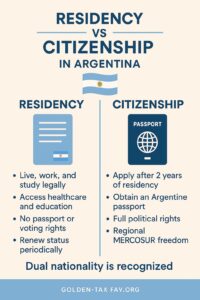
Applying for Argentine Citizenship is a surprisingly accessible and straightforward process for many foreigners. However, its simplicity largely hinges on one crucial factor: understanding how the system truly works, and that means learning to “speak its language.” The legal framework governing Argentine Citizenship in Argentina is a fascinating blend of civil law principles, fundamental constitutional rights, and a rich history of court precedents. For individuals unfamiliar with the nuances of Latin American legal systems, some of the terminology can be confusing, easily misinterpreted, or even misleading.
Whether you’re just beginning to explore the possibility of Argentine Citizenship or you’re already consulting with a lawyer, familiarizing yourself with the most common legal terms used in these cases will undoubtedly save you significant time, money, and frustration. Knowing these terms empowers you to ask the right questions, understand the advice you receive, and monitor your application’s progress effectively. Here’s what you need to know if you’re preparing to become an Argentine citizen in 2025.
Nacionalización por Residencia
This term defines the primary legal pathway that the vast majority of foreigners utilize to apply for Argentine Citizenship. Nacionalización por residencia refers to the process of acquiring Argentine Citizenship after having legally resided in the country for a continuous period of at least two years. Unlike many other nations that typically demand prior permanent residency status, Argentina’s system is more accommodating, requiring only a verifiable, continuous, and legal presence within its borders for the minimum specified period (Ley 346, Art. 2, 1869; ACNUR Argentina, 2023).
This remarkably flexible approach is rooted in Law 346, Argentina’s foundational legislation on Argentine Citizenship, which was originally enacted in 1869 and, despite minor updates, remains the cornerstone of naturalization policy. The law reflects Argentina’s historical commitment to immigration and its welcoming stance towards those who choose to make the country their home. This makes the two-year residency requirement one of the shortest and most accessible pathways to citizenship globally.

Useful Resources on Argentine Citizenship by Residency
Domicilio Real
In Argentine legal terms, domicilio real translates to your actual, physical place of residence, where you genuinely live day-to-day and maintain your habitual presence. This concept is absolutely crucial in Argentine Citizenship cases because the fundamental two-year residency requirement must be demonstrably based on your continuous and tangible domicilio real within Argentina. It’s not merely a formal address, a temporary tourist lodging, or a legal fiction; it must be where your life unfolds.
Argentine federal courts place significant emphasis on proving your domicilio real when evaluating applications for Argentine Citizenship. They will typically request evidence that substantiates your continuous physical presence. This can include a range of documents such as:
- Official rental agreements (contratos de alquiler)
- Utility bills (electricity, gas, water, internet) in your name
- Bank statements showing local transactions and address
- Employment contracts or proof of income
- Certificates of school enrollment for children
- Medical records from local clinics
- Testimonies or affidavits from neighbors or local community members
- Immigration entry and exit stamps in your passport, demonstrating an uninterrupted stay.
The more solid, consistent, and continuous your evidence of domicilio real, the smoother your citizenship application is likely to proceed, as it directly addresses a core legal requirement (Estudio Jurídico Rugeles, 2022).
Useful Resources on Domicilio Real in Argentine Citizenship
DNI (Documento Nacional de Identidad)
The DNI, or Documento Nacional de Identidad, is Argentina’s national identity card. While it’s not technically an absolute prerequisite to initiate the Argentine Citizenship application itself, obtaining and holding a DNI throughout your two-year residency period is strongly recommended and immensely beneficial. The DNI serves as concrete proof of your integration into Argentine society; it helps substantiate your legal residence, facilitates tax interactions, and demonstrates social ties.
Foreigners initially obtain a temporary or permanent DNI through the Dirección Nacional de Migraciones (DNM) once their residency status is approved. For Argentine Citizenship purposes, having a DNI that has been continuously valid and updated for at least two years before your naturalization application often simplifies the approval process by providing clear, official documentation of your continuous legal presence (Registro Nacional de las Personas – RENAPER, 2022). Once Argentine Citizenship is granted, you will receive a new DNI signifying your status as an Argentine citizen.

Prueba de Buena Conducta
Prueba de buena conducta literally means “proof of good conduct,” and it constitutes one of the mandatory documentation requirements for citizenship. This step is fundamental to ensuring that applicants are law-abiding individuals who will contribute positively to Argentine society. Typically, you will be required to submit:
- Argentine National Police Record (Certificado de Antecedentes Penales): This is obtained from the Registro Nacional de Reincidencia (part of the Ministry of Justice and Human Rights) and covers any criminal history within Argentina.
- Criminal Background Check from Your Country of Origin: This document must be issued by the relevant authority in your home country, and then properly legalized and apostilled (or authenticated by an Argentine consulate if your country is not part of the Hague Apostille Convention).
- Additional Certifications: In some cases, particularly if you’ve lived for extended periods in other countries recently, the judge may request criminal background checks from those jurisdictions as well.
Expediente
Once you officially file your Argentine Citizenship application with the federal courts, your case transforms into an expediente. This is a formal, physical, and increasingly digital legal file that meticulously compiles every single document, piece of evidence, court order, hearing transcript, and decision related to your application. Your case will be assigned a unique número de expediente (case number), allowing you or your legal representative to track its progress within the public judicial system.
Understanding how to track and manage your expediente in the context of Argentine Citizenship is crucial. It enables you to proactively monitor the status, anticipate next steps, and respond quickly if the court requests additional documentation or clarification. Many federal courts provide online portals for public access to expediente status, though a lawyer often has more detailed access and can provide expert guidance on judicial timelines (Poder Judicial de la Nación, 2025). Effective management of your expediente can significantly help to avoid unnecessary delays and ensure a smoother process toward Argentine Citizenship.
Sentencia Judicial
A key distinction of the Argentine Citizenship naturalization process is that the final decision to grant citizenship is not made by a government agency or migration office, but rather by a Federal Judge, who issues a sentencia judicial (judicial ruling). This judicial oversight inherently lends a greater degree of transparency, due process, and fairness to the procedure. It allows applicants the invaluable opportunity to explain any complexities, provide additional context, or resolve doubts directly before a judicial authority, rather than being subject to purely administrative discretion (SAIJ, n.d.a; CIJ, 2023).
Once the sentencia is issued and your Argentine Citizenship is formally granted, the judge officially forwards this ruling to the Registro Civil (Civil Registry) to be recorded. This judicial approval is the definitive legal act that bestows Argentine Citizenship upon you.
Juramento de Ciudadanía
Upon the judge’s approval of your citizenship, you will be invited to participate in the juramento de ciudadanía, or oath of citizenship. This is a ceremonial, yet legally required, final step in the naturalization process. Often conducted in a courtroom setting, this solemn occasion involves you formally pledging loyalty to the Argentine Republic and its Constitution.
During the juramento, applicants typically affirm their commitment to the fundamental principles and values of the nation. While largely symbolic in nature, it is a mandatory public declaration of your new allegiance before your citizenship can be fully formalized and your national identity documents issued. It marks your official entry into the Argentine body politic (Ministerio de Justicia y Derechos Humanos, 2004).
Registro Civil
Following the sentencia judicial and the completion of your juramento de ciudadanía, your newly acquired status as an Argentine citizen must be officially registered at the Registro Civil (Civil Registry). This is the public office responsible for recording vital events such as births, deaths, and marriages. For naturalized citizens, this is where your original birth record as an Argentine citizen is created, even though you were born abroad.
This official record is paramount. It serves as the foundational document that you will subsequently use to apply for your new Argentine DNI and, eventually, your Argentine passport. Without this crucial registration, you are not yet fully recognized as a citizen in practical terms, regardless of the judicial approval. The Registro Civil effectively translates the legal ruling into tangible, verifiable documentation of your citizenship (Registro Nacional de las Personas – RENAPER, 2024).
Doble Nacionalidad
Argentina explicitly recognizes and permits doble nacionalidad, or dual citizenship. This means that upon becoming an Argentine citizen, you are generally not required to renounce your original nationality. This is a significant advantage, as it allows you to retain ties and benefits with your country of origin while fully embracing your new Argentine identity.
However, it’s vital to remember that while Argentina allows dual citizenship, the acceptance of doble nacionalidad also depends entirely on the laws of your country of origin. For example, countries like the United States, Canada, and many in Europe generally allow dual citizenship, while others, such as Germany (with some exceptions) or Japan, may require you to renounce your previous nationality.
As an Argentine citizen, holding dual nationality can also unlock additional benefits, especially due to Argentina’s extensive network of dual nationality agreements with countries like Spain, Italy, and numerous other Latin American nations. These agreements often simplify residency, work, and even further citizenship processes abroad, enhancing your global mobility (Argentina.gob.ar, 2025).
Useful Resources on Dual Citizenship in Argentina
- Ministerio de Relaciones Exteriores y Culto – Argentina
- Ministerio de Justicia y Derechos Humanos de la Nación
- Dirección Nacional de Migraciones – Argentina
- U.S. Department of State – Dual Citizenship Information
- Government of Canada – Dual Citizenship
- Ministerio de Justicia de España – Nacionalidad y Doble Nacionalidad
- Ministero degli Affari Esteri – Ciudadanía Italiana y Doble Nacionalidad
Inmigración Irregular
The term inmigración irregular refers to periods where an individual has overstayed a visa, entered the country without proper documentation, or otherwise resided in Argentina without legal authorization. While it is always advisable to maintain regular immigration status, Argentina’s naturalization system is often cited as one of the most forgiving globally regarding past periods of irregularity.
Unlike many countries where any history of irregular immigration can automatically disqualify an applicant for citizenship, Argentine judges can, and often do, still grant citizenship to individuals who have experienced periods of irregular status. This is particularly true if the applicant can demonstrate a genuine, long-term commitment to the country through sustained residence, stable work, strong social integration, and a consistent record of good conduct. Several legal precedents from federal courts and even the Supreme Court support this more flexible and human rights-oriented approach, making Argentina notably unique in how it balances the rule of law with a compassionate understanding of migration realities. (Fiscales.gob.ar, 2024; SAIJ, 2025).
Useful Resources on Irregular Immigration and Citizenship in Argentina
- Dirección Nacional de Migraciones – Argentina
- Ministerio de Justicia y Derechos Humanos de la Nación
- Ministerio Público Fiscal – Argentina
- SAIJ – Sistema Argentino de Información Jurídica
- Centro de Información Judicial (CIJ)
- Corte Suprema de Justicia de la Nación
- ACNUR Argentina – Protección y Migración
Know the Terms, Own the Process
Argentina’s citizenship process is remarkably accessible, but its accessibility is profoundly amplified if you invest the time and effort to understand its underlying rules and the specific legal vocabulary involved. By familiarizing yourself with these key legal terms, you gain the power to more effectively navigate the judicial system, communicate clearly and confidently with your lawyer or the court, and ultimately present a stronger, more coherent application from day one.
Knowing what domicilio real truly entails, comprehending how your expediente progresses through the courts, understanding the significance of the sentencia judicial, and being prepared for the symbolic yet essential juramento de ciudadanía are all critical steps. These insights will undoubtedly separate those who achieve quick success from those who encounter unnecessary hurdles and delays.
Your ultimate goal isn’t just to acquire an Argentine passport; it’s to become a full, recognized participant in Argentine society.