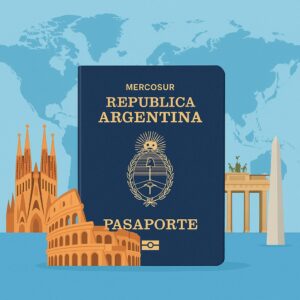
Argentina is one of the most open and accessible countries in Latin America for foreigners who want to build a life, start a business, study, or retire. In the Citizenship vs Residency debate, the country stands out with generous residency laws, a clear path to citizenship, and a vibrant lifestyle that mixes European culture with Latin warmth. Many people ask the natural next question: should you get residency or go all the way to citizenship

What Does Residency in Argentina Offer?
Residency, both temporary and permanent, allows you to live, work, and study in Argentina legally. In the Citizenship vs Residency debate, residency is often the first step. You can apply for it through various routes: retirement, work, investment, family reunification, or even by being married to an Argentine.
Temporary residency is usually valid for 1 year and can be renewed. After two years of continuous legal residence, most people become eligible to apply for permanent residency (Golden Harbors, 2025).
With residency, you get:
Access to Argentina’s public healthcare and education systems, which are generally free for residents (Armenian Immigration Lawyers, 2025; Expat Arrivals, n.d.).
The right to rent long-term, open bank accounts, and sign legal contracts.
A CUIT number (Unique Tax Identification Code) for work or business activities (Golden Harbors, 2025).
Freedom to come and go from the country, though extended absences may affect your status or renewal (Immi Legal, 2025).
But there are limits; You can’t vote in national elections, you don’t automatically get an Argentine passport, and you’re still under the control of immigration authorities, which may require periodic renewals or proof of continued ties to Argentina to maintain your status.
Useful Resources on Citizenship vs. Residency in Argentina
What Does Argentine Citizenship Get You?
Here’s where Argentina stands out from most of the world. In the Citizenship vs Residency comparison, Argentina is unique because you can apply for citizenship after just 2 years of continuous legal residence, even if that residence was on a temporary visa (Ley 346, Art. 2, 1869; iWorld, 2025). That’s faster than almost anywhere in Latin America, and far faster than countries like Spain or Italy, which can take 10 years or more (Ministerio de Justicia de España, 2024).
With Argentine citizenship, you get:
A passport that gives visa-free or visa-on-arrival access to over 170 countries, including the EU Schengen Zone, Russia, Japan, South Korea, and much of Latin America (Henley & Partners, 2025).
Full political rights, including the ability to vote, run for office, and hold public service positions.
The right to live and work freely in any MERCOSUR country (Brazil, Uruguay, Paraguay, Bolivia, etc.) with fewer bureaucratic steps, effectively providing a regional passport (Citizenship of the Mercosur, n.d.).
Citizenship for your minor children born in Argentina, and a simplified path for your spouse to obtain residency or citizenship.
And here’s the kicker: Argentina fully recognizes dual and even multiple nationalities (Argentina.gob.ar, 2025). You don’t have to give up your current citizenship, offering immense flexibility and a valuable “Plan B.”
Useful Resources on Citizenship vs. Residency in Argentina
Residency Is Easier, But Citizenship Is More Powerful
For many foreigners, especially digital nomads or entrepreneurs, obtaining temporary residency is sufficient for the short-term. In the Citizenship vs Residency debate, this option integrates you into the system and allows you to live your life in Argentina with fewer bureaucratic hurdles than being on a tourist visa.
However, if you envision building a long-term life, investing significantly, or desire the full benefits and security of being an integral part of Argentina’s legal and political system, citizenship is clearly the superior choice.
Many expats later express regret for not applying for citizenship sooner, particularly when they realize that the crucial 2-year residency requirement for citizenship is counted from your first date of legal residence, not necessarily from when you transition to permanent residency (Immi Legal, 2025).
Is It Difficult to Get Citizenship?
Surprisingly, no. While Argentina’s bureaucracy can, at times, be slow or inconsistent, the fundamental legal framework is remarkably favorable to applicants. In the Citizenship vs Residency context, this makes citizenship far more accessible than in most countries.
You typically need to provide:
Proof of two years of continuous legal residence (Ley 346, Art. 2, 1869).
Proof of income or sufficient means of support to sustain yourself (iWorld, 2025).
A clean criminal record from both your home country and Argentina (iWorld, 2025).
An application submitted to a federal court with the assistance of a lawyer; Argentine citizenship is granted by a federal judge, not directly by an immigration office (Poder Judicial de la Nación, 2022.).
Crucially, you don’t need to speak fluent Spanish, take a formal language test, or pass a civics exam to qualify. While judges may prefer applicants to demonstrate some level of integration into Argentine society, many cases have been successfully approved with intermediate or even basic Spanish proficiency and without any formal cultural test (Abogado Garrido, 2023).
What If You Want Both?
You can absolutely start with residency and later apply for citizenship. In fact, this is the most common and often recommended path. In the Citizenship vs Residency journey, beginning with residency allows you to establish documentation, open bank accounts, and gather proof of income, which makes the citizenship application process significantly smoother.
Just be aware that if you frequently leave the country or for long periods during the initial two years of residence, you might interrupt your “continuous residence” requirement. It’s generally best to maintain a consistent presence in Argentina during those first two years if your goal is to pursue citizenship.
So, Which One Is Worth It?
So, which one is worth it? When comparing Citizenship vs Residency, the decision depends entirely on your goals in Argentina.
Choose Residency If:
You want to test the waters before making a long-term commitment to the country.
You’re not yet certain if you want to stay more than a year or two.
You’re primarily working remotely or studying and don’t immediately require the full benefits of an Argentine passport.
Choose Citizenship If:
You’re planning to build a long-term life in Argentina or wish to retire there permanently.
You desire full legal rights and the strategic advantage of a powerful second passport.
You seek maximum legal security and long-term peace of mind in Argentina.
You anticipate wanting the freedom to live and work within other MERCOSUR countries later on.
You want the right to vote and engage fully in Argentina’s political life.
Argentina offers both paths as genuine opportunities, but understanding the nuances of Citizenship vs Residency ensures you make the smartest choice for your future.
Argentina Is Truly The Best Option
Argentina offers a truly unique and compelling opportunity for global citizens. It provides an open door, a clear and exceptionally fast path to citizenship, and a society where foreigners can integrate deeply without being forced to relinquish their original national identity.
If you’re looking for a country that grants you a wide array of options, both for the short and the long term, there are few places in the world that can genuinely rival Argentina.
Ultimately, whether you begin your journey with residency or decide to go all-in on citizenship, the Citizenship vs Residency choice becomes a smart strategic move in a country that values inclusion, global mobility, and accessibility for foreigners.