

For decades, Argentina has attracted adventurers, investors, and culture lovers, but now, a quieter trend is starting to gain steam. Foreign buyers are increasingly Buying Real Estate in the Argentine market without even needing residency. With Buenos Aires offering Parisian charm at Latin American prices, this might just be the best-kept property secret on the continent.
Yes, You Can Buy Property Without Being a Resident
In Argentina, you do not need to be a legal resident or citizen to buy real estate. This applies to both residential and commercial properties, and it’s perfectly legal (Multilaw, 2025). The only requirement is obtaining a CDI (Clave de Identificación), a tax identification code issued by the Federal Administration of Public Revenues (AFIP) (Study BA, 2024).

Once you have the CDI, you’re treated the same as any Argentine buyer when it comes to property ownership. There are no restrictions on foreign land ownership in urban areas. However, Law 26,737 (passed in 2011, and modified in 2016 by Decree signed by President Mauricio Macri) limits foreign ownership of rural land to 15% of the total rural land in the national territory, with specific caps per nationality and size, and also restricts ownership in “frontier zones” without prior authorization (AgWeb, 2020; Gateway to South America Newsblog, 2024).
The Buying Process Explained
Even without legal residency, foreigners can successfully navigate the process of buying real estate by working with a reputable real estate agent, an escribano (notary public), and a local lawyer. The steps typically include:
Finding a suitable property.
Making an offer, commonly in US dollars (BuySellBA, 2025).
Signing a boleto (preliminary contract).
Paying via a secure transaction, often in cash or through escrow.
Finalizing the escritura (title deed) before a notary, as required by the Civil and Commercial Code (Multilaw, 2025).
In most cases, the entire transaction can be completed within 30 to 60 days, particularly for all-cash offers (ESAGOFF LAW GROUP, 2016; Reddit, 2024).
Cash Is King, and That’s to Your Advantage

Many Buying Real Estate transactions in Argentina are still conducted entirely in US dollars and often involve physical cash (BuySellBA, 2025). While this may seem old-fashioned, it gives foreign buyers who already hold USD a significant advantage.
It’s one of the few places in the world where coming in with cash really gives you leverage.
No Mortgage? No Problem.
One of the key reasons Argentina is accessible for non-residents is mortgage availability. With interest rates historically high, the Buying Real Estate market has largely operated on a cash basis (BuySellBA, 2025).
Recent reforms under President Milei have led to a significant increase in mortgage availability and demand, with banks expected to issue approximately US$3 billion in 2025, a substantial rise from previous years (Buenos Aires Times, 2025). However, many transactions continue to be cash-based, simplifying the process by eliminating complex financing, bank interviews, and credit checks. You can buy real estate simply.
Where Foreigners Are Buying Right Now
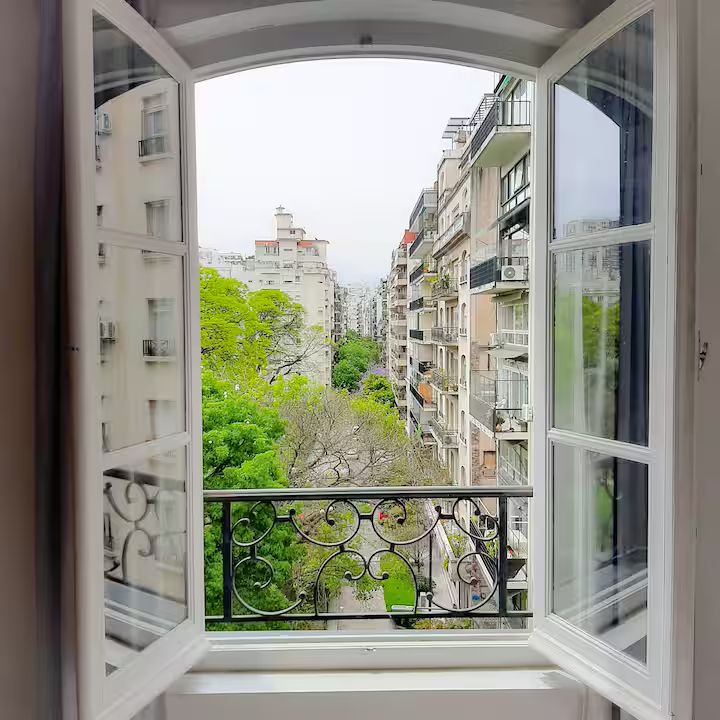
Buenos Aires remains the main hub for foreign Buying Real Estate. Neighborhoods like Palermo, Recoleta, and San Telmo offer European architecture, walkability, and vibrant lifestyles. Foreign buyers are also increasingly exploring cities like:
Mendoza, renowned for its wine country and attractive cost of living.
Córdoba, offering a youthful energy, large student population, and proximity to nature.
Bariloche, ideal for Patagonia lovers seeking lakefront views and outdoor activities.
These places offer a high quality of life and even better real estate deals, especially for those looking outside the capital.

Taxes and Fees: Know What You’ll Pay
While Buying Real Estate in Argentina is simple, there are a few costs to be aware of:
Real estate commission: Typically 3–4% of the purchase price, usually paid by the buyer.
Notary and legal fees: Around 1–2% of the property value.
Transfer taxes: These vary by province but are often around 3% of the purchase price. A stamp tax of 3.6% is generally split evenly between buyer and seller, though buyers may pay all of it for new construction (BuySellBA, 2025).
There is no additional tax specifically for foreign real estate buyers. You will also need to pay annual property taxes, known as Impuesto a los Bienes Personales (IBP), which typically range from 0.25% to 1.5% of the property’s assessed value and are considered low by international standards (Expat Focus, 2024; Live and Invest Overseas, 2025).
If you plan to rent out the property, be aware of income taxes (flat 21% for rental properties for non-residents) and the need to declare your earnings, especially if using short-term platforms like Airbnb (Live and Invest Overseas, 2025).
Why This Matters in 2025
Under President Javier Milei’s reforms, Argentina is gradually becoming more open to international markets. Deregulation efforts, including the repeal of the rent control law in late 2024 which significantly increased rental housing supply (Newsweek, 2025), and the easing of foreign exchange controls (known as el cepo), have contributed to greater interest from foreign investors in 2025 (Newsweek, 2025; Latina Republic, 2024).
This window may not stay open forever. With property prices still historically low, having experienced a significant real-term price drop over recent years, but now showing signs of recovery and rising demand, getting in now could offer long-term capital growth, or at the very least, an affordable entry into a world-class city (Gateway to South America Newsblog, 2025). Experts forecast that Buenos Aires property prices could rise 10-20% in 2025 (Gateway to South America Newsblog, 2025).
Take This Opportunity!
Argentina is one of the only countries in Latin America where you can legally and easily engage in Buying Real Estate as a foreigner with no strings attached. You don’t need to be a resident, citizen, or even fluent in Spanish, although that certainly helps.
If you’re looking for a base in South America or simply a smart investment in a buyer’s market, Argentina, and especially Buenos Aires, offers a rare mix of accessibility, legal clarity, and charm.
Useful resources for Buying Real Estate in Argentina:


